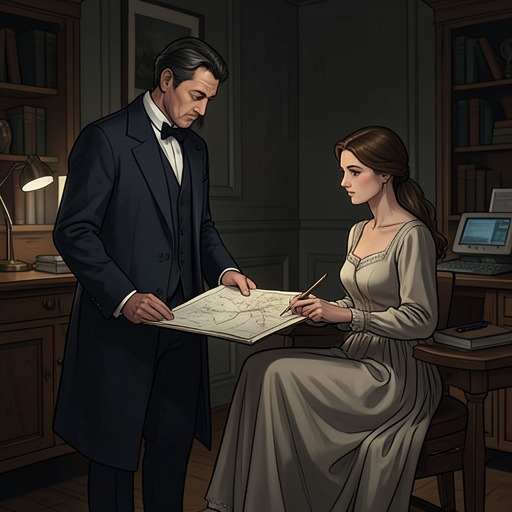
Tad and Lady Love
One Thousand and One NightsTad and Lady Love’s relationship combines authority, playful manipulation, and a lesson in shared responsibility. Lady Love appoints Tad as an avenging agent, but Tad interprets the role as evidence of his own primacy; when he insists that Claire is merely an assistant, Lady Love corrects him and later reveals that she has bound their magic together so neither can work without the other. Her oversight is affectionate in its mischief, but it is also decisive: she uses her authority to make Tad confront the partnership he had refused to recognize.
Appointment and Tad’s Understanding
Lady Love’s appointment gives Tad a place among her avenging agents, a role he treats as both an honor and a claim to distinction. When Sev suggests that Claire may already have solved a case, Tad insists that he is the avenging agent and describes Claire as an assistant, or an agent in training. His self-serving qualification that he had granted her this title out of pity reveals how readily he turns shared service into a hierarchy with himself at its summit.
Nan directly corrects him: Lady Love made both Tad and Claire avenging agents. The distinction matters because Tad’s account is not merely a boast about rank; it distorts the terms of the appointment and discounts his partner’s standing. Lady Love’s authority encompasses them both, even when Tad tries to recast their relationship as master and subordinate.
Authority, Rules, and Protection
The relationship is not expressed only through rank. Tad also experiences Lady Love’s protection as a concrete privilege: he believes she has granted him a pigeon-free zone, and the thought fills him with delight, to the point that he imagines writing a poem about it. Pip and Sev explain that they cannot enter Tad’s most private chambers unless invited. Tad takes advantage of that boundary to dismiss them and demand solitude, only to find feathers where he expects his book and discover Nan in the room.
The episode gives Lady Love’s influence a comic, indirect shape. Tad assumes her authority has made his private space inviolable, but the scene does not establish that the protection applies to every visitor or that Lady Love personally arranged Nan’s presence. What it does show is how readily Tad interprets the rules surrounding his role as personal favors—and how his confidence in solitude can be punctured by events he did not anticipate.
The Secret Behind the Partnership
Lady Love’s clearest intervention comes after Tad and Claire have tried to establish which of them matters more. She admits that she has secret informants, while specifying that Pip, Sev, Nan, and Wigamus were not the ones who reported to her. She had instructed those agents to leave Tad and Claire to their own devices, so they could learn from the case rather than receive help that would settle their rivalry for them.
Her explanation turns their ordeal into a deliberate lesson. Tad and Claire have gone to considerable trouble, only to return to the same conclusion: neither has proved more important than the other. Lady Love then states the mutual dependence plainly. Claire cannot solve a case without Tad, and Tad cannot solve one without Claire. She has entwined their magic, ensuring that neither can work apart from the other. The bond is therefore not a partnership Tad has freely chosen on equal terms; it is a condition Lady Love secretly imposed, and the case makes its purpose legible to both agents.
A Playful but Decisive Mentor
Lady Love does not present her method as gentle instruction. She says that watching the two agents struggle was amusing, then sweeps away in a flurry of rose petals. The theatrical exit preserves her air of mischief, while her decision to withhold assistance shows that her playfulness has consequences: she lets Tad and Claire experience the limits of separation before disclosing the bond that makes their cooperation necessary.
Tad’s response is reluctant and comic. He concludes that he is stuck with Claire and Claire is stuck with him, calling the arrangement a calamity, even as he admits that at least he can have some fun with her. The shift is modest but meaningful: Lady Love does not turn Tad into an ungrudging partner, yet she replaces his unilateral claim to importance with a relationship in which neither agent can stand alone. Her authority is effective precisely because it changes the practical conditions of his work, not just the language he uses to describe it.
The Limits of Tad’s Perspective
Tad’s early certainty that he occupies the central role contrasts with Lady Love’s broader knowledge and longer view. He imagines himself the principal agent, assumes he can dismiss others, and delights in what he takes to be a personal protection. Lady Love, by contrast, has arranged circumstances that reveal the mutual dependence beneath his self-image. Her secret intervention does not erase his vanity, but it makes his preferred hierarchy impossible to maintain in practice.
That contrast defines the relationship’s narrative function. Lady Love is both Tad’s superior and the architect of a corrective test: she allows his rivalry with Claire to run until its failure becomes undeniable, then reveals the hidden magical bond that has governed their work all along. The result is not a sentimental reconciliation so much as an imposed recognition. Tad may still call the partnership a calamity, but he can no longer claim that its other half is merely an assistant.